Tina Patterson · 17 September 2026
Symbiotic Dynamics Between Lichens and Their Invertebrate Partners in Forest Canopies
Lichens form intricate networks within forest canopies where fungal and algal components create composite organisms that colonize bark and branches at heights often exceeding thirty meters, and these structures support diverse invertebrate communities through provision of microhabitats, moisture retention, and organic matter that serves as both food and shelter while the partners contribute to lichen propagation and nutrient cycling in return.
Composition and Distribution of Canopy Lichens
Researchers have documented that canopy lichens such as those in the genera Usnea and Lobaria establish themselves primarily in temperate and boreal forests where humidity levels remain elevated due to reduced wind exposure and frequent fog interception, and studies from the United States Department of Agriculture show that these lichens cover up to twenty percent of branch surfaces in old-growth stands creating vertical stratification that favors specific invertebrate assemblages at different heights.
Key Invertebrate Groups Involved
Oribatid mites, springtails, and certain beetle larvae dominate the invertebrate partners observed in these systems, and data from Natural Resources Canada indicates that oribatid populations can reach densities of several thousand individuals per square meter of lichen thallus because the porous structure traps detritus and maintains stable microclimates that protect against desiccation during dry periods.
Mechanisms of Symbiotic Interaction
Invertebrates graze on lichen tissues yet simultaneously transport fungal spores and algal cells via their exoskeletons and digestive tracts, which facilitates colonization of new substrates higher in the canopy, and this process accelerates during periods of active growth when lichen fragments adhere to the legs of mites or the bodies of collembolans that move between adjacent branches. What's interesting is how some species of bark lice actively farm algae within lichen mats by maintaining clearings that promote algal photosynthesis while receiving protection from predators through the lichen's secondary metabolites.
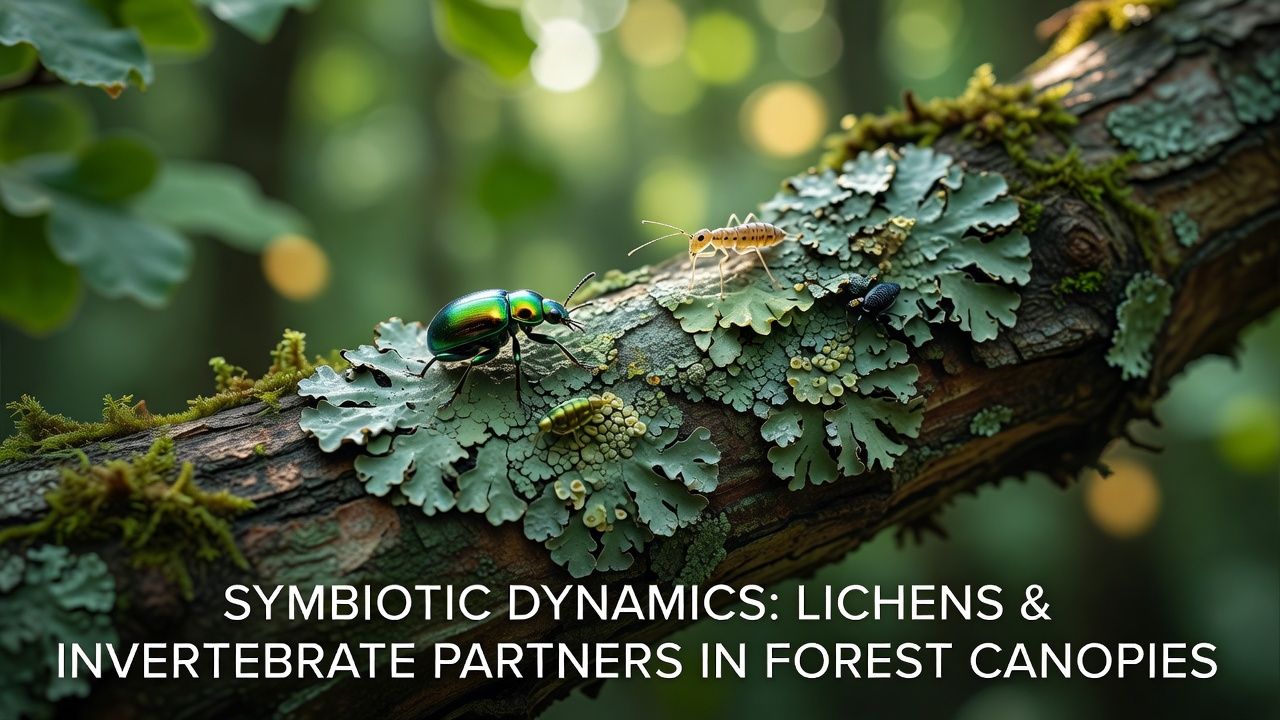
Evidence from long-term monitoring plots reveals that lichen-invertebrate associations strengthen during seasonal transitions when canopy moisture peaks, and researchers note that dispersal events peak in late summer because invertebrate activity coincides with the release of lichen soredia and isidia. But here's teh thing, these relationships also buffer against environmental stressors since lichens provide chemical defenses that invertebrates sequester for their own protection against birds and parasitic wasps.
Ecological Roles and Nutrient Flows
Nutrient transfer occurs when invertebrates fragment lichen material and deposit frass that enriches the canopy soil layer, which in turn supports epiphyte succession, and figures from European forest research networks demonstrate that this internal cycling contributes measurable amounts of nitrogen and phosphorus to the broader ecosystem without relying on ground-level inputs. Observers note that canopy invertebrates also influence lichen morphology by selective grazing that shapes thallus architecture, creating more porous forms that enhance water storage capacity for the entire community.
One study revealed that removal of key invertebrate groups through targeted exclusion experiments led to reduced lichen expansion rates on experimental branches, confirming the reciprocal nature of the partnership, and such findings align with observations from Australian canopy studies where similar dynamics appear in eucalypt forests despite different lichen species compositions.
Current Research Directions
Investigations continue into how climate shifts affect these canopy interactions, particularly as temperature increases alter humidity gradients that sustain both lichens and their partners, and recent monitoring programs have begun tracking changes across multiple continents to identify patterns that emerge when invertebrate diversity declines. Those who've studied this know that molecular techniques now allow precise mapping of microbial communities within lichen thalli, revealing additional layers of symbiosis that involve bacteria and yeasts which indirectly support invertebrate nutrition.
Conclusion
The symbiotic dynamics between lichens and invertebrates in forest canopies represent a layered system of mutual benefits that sustain biodiversity at multiple trophic levels, and ongoing data collection continues to clarify how these relationships integrate into larger forest processes. As research expands, the connections between canopy partners and overall ecosystem stability become clearer through coordinated studies that span different forest types and geographic regions.